Illustrated Guide to Understanding a Watershed
Talking about water replenishment without understanding how a watershed works is to approach water in a fragmented way—as if it were an isolated input rather than the outcome of a complex network of natural processes. Water is neither created nor lost arbitrarily: it circulates, infiltrates, runs off, evaporates, is stored, and transforms according to precise physical, ecological, and temporal rules. Gravity determines where it flows; soils and vegetation define how much infiltrates or is lost; and time—days, years, or even decades—determines when that water becomes available again. In countries like Mexico—where there is an extensive network of aquifers, yet a significant proportion is overexploited—understanding these processes is no longer just a technical matter. It becomes a fundamental condition for water, climate, and productive sustainability.
This illustrated guide was created with a clear purpose: to bring people closer to how water actually behaves across landscapes. It aims to explain, in an accessible yet rigorous way, how a watershed functions, what determines the fate of rainfall, and why not all rainfall becomes available water. Like any illustrated manual that helps simplify complex systems, this document seeks to connect the reader—whether technical expert, decision-maker, or corporate actor—with the natural logic that makes clean, potable, or process-ready water possible.

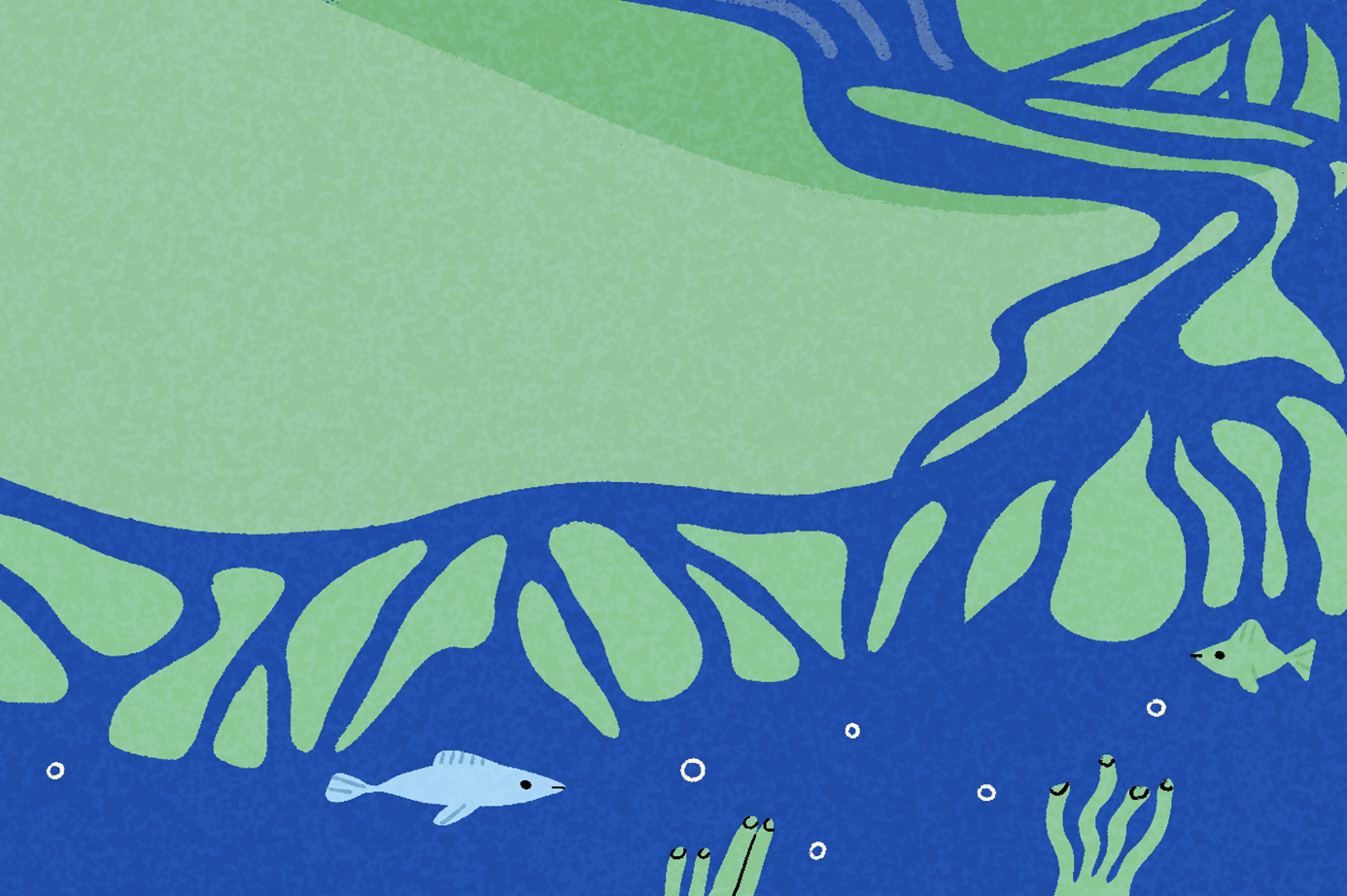
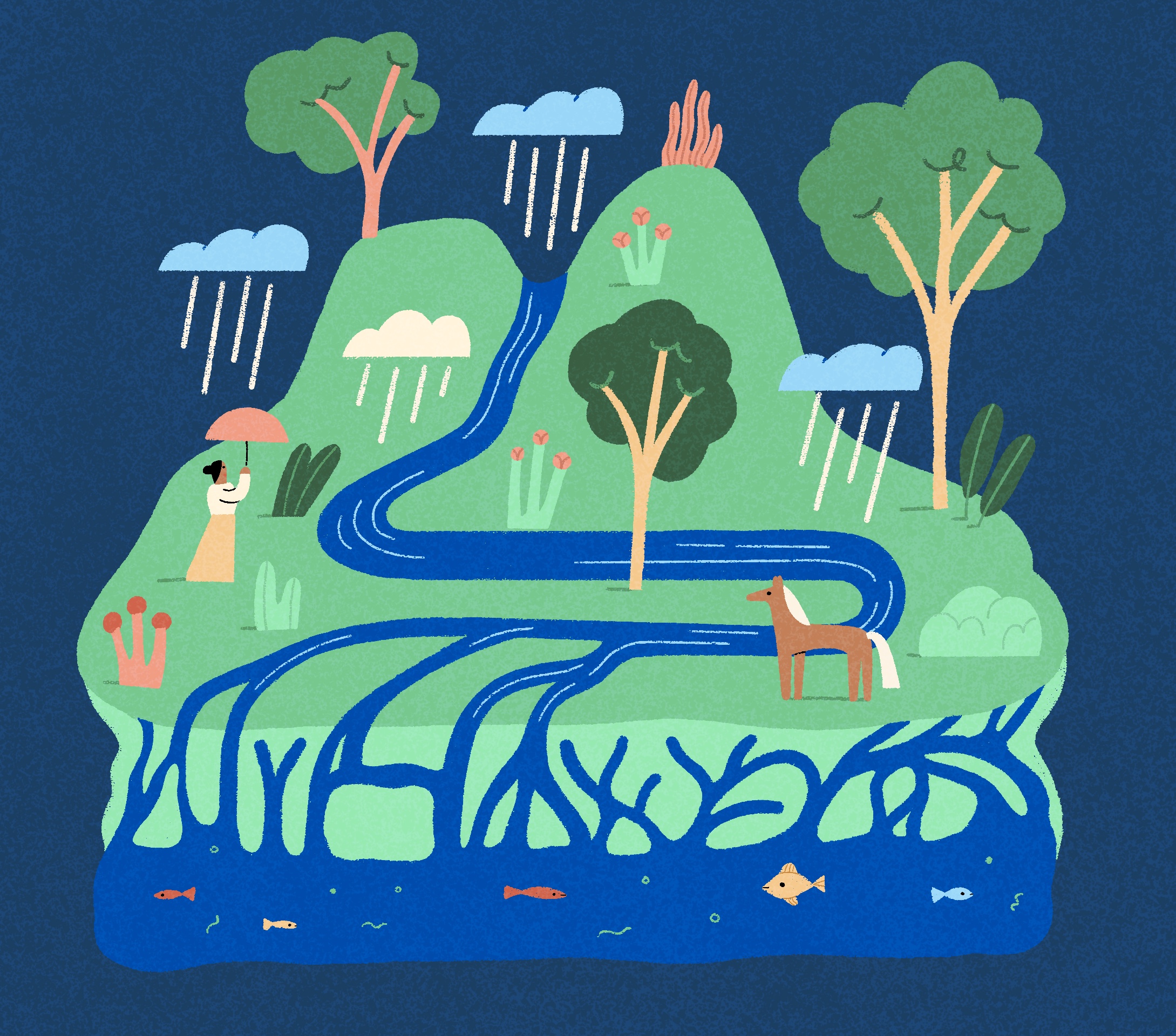
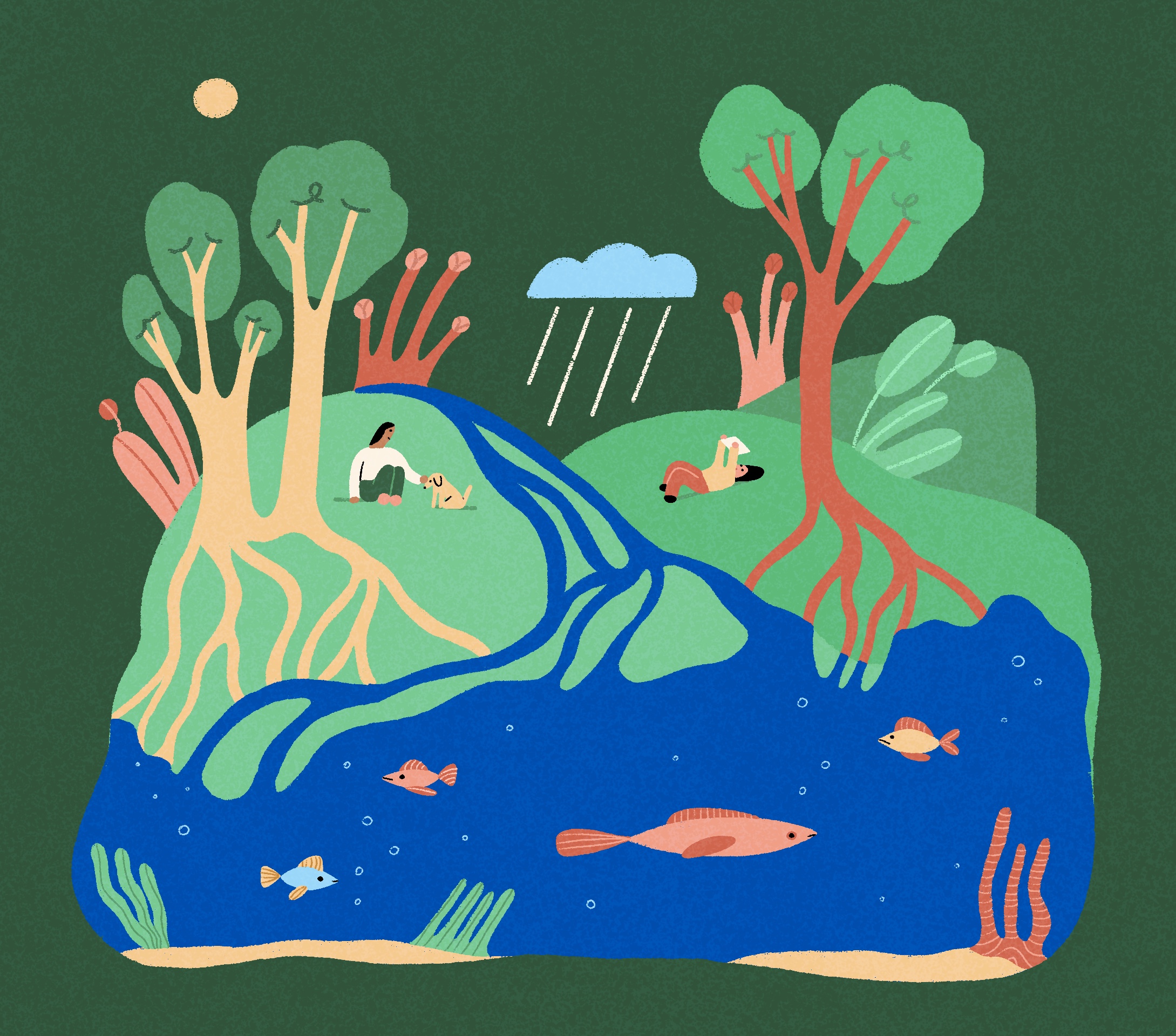
A watershed is the natural system that organizes the movement of water across a landscape. It is defined by topographic boundaries—hills and mountains—and functions as a large catchment surface: all rainfall within it flows, driven by gravity, toward a common outlet, whether a river, lake, wetland, or the ocean.
But a watershed is not only what we see on the surface—it also has an “invisible” component. Some water flows across the land as runoff, while another portion slowly infiltrates the soil and feeds underground aquifers. These aquifers, in turn, sustain springs, rivers during dry seasons, and a large share of the water used for human consumption, agriculture, and industry. Surface and subsurface are part of the same system: what happens above determines how much water exists below, how long it takes to get there, and in what condition.
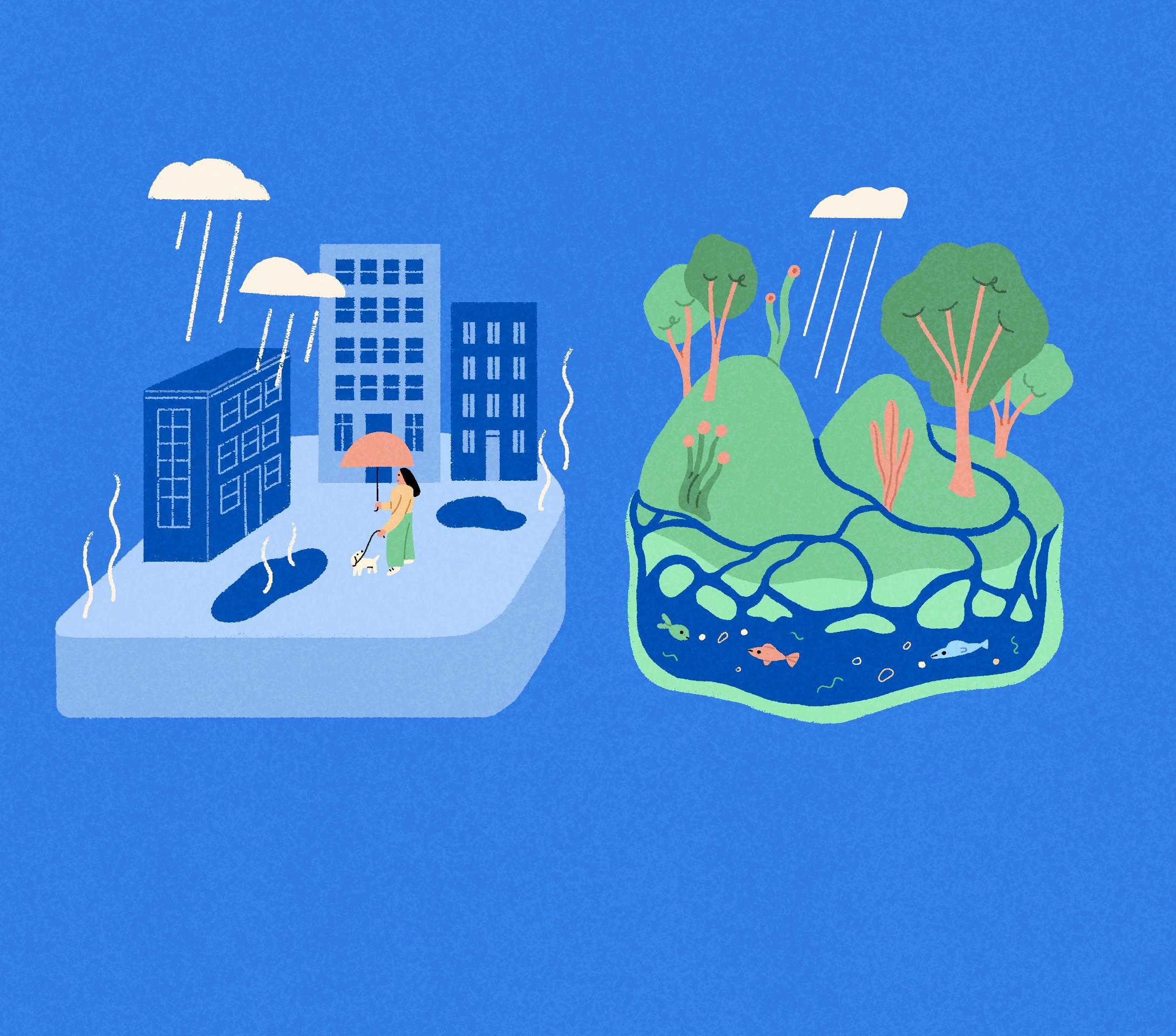
From a hydrological perspective, the watershed is the most logical unit for water management because everything is connected. Deforestation in upper areas can increase runoff and erosion, carrying sediments and pollutants downstream. Soil compaction in agricultural areas reduces infiltration and limits aquifer recharge, as the soil loses its capacity to function like a sponge. Urbanization accelerates flows, reduces natural absorption due to impermeable surfaces, and increases flood risk. Nothing happens in isolation.
For companies and productive operations, this has direct implications: the water available for a plant, field, or city is not generated at the point of extraction—it is shaped across the entire watershed. Its quantity, quality, and reliability depend on decisions made kilometers upstream, often outside a company’s operational boundaries.
Nature-based solutions (NbS) are widely used ecological restoration tools designed to restore the functional health of watersheds. They are grounded in a systemic understanding of the territory, although they do not necessarily intervene across its entire extent. In practice, many NbS are implemented in specific, strategic locations—eroded slopes, recharge zones, riverbanks, degraded soils—where key ecological processes can be activated or restored to influence the watershed’s hydrological behavior as a whole.
By mimicking or restoring natural processes—such as water infiltration in structured soils, flow regulation through vegetation, or gradual moisture retention in the landscape—these targeted interventions can generate effects that extend beyond their immediate location. They do not replace comprehensive watershed management, but when well-sited, well-designed, and context-aware, they significantly improve hydrological function.
Managing a watershed does not mean intervening in every square meter—it means understanding where and how soil, vegetation, water, climate, and people interact, and acting where natural processes can be strengthened. From this perspective, NbS become an effective pathway toward water replenishment that is realistic, measurable, and lasting—precisely because they work with, rather than against, the logic of natural systems.
Every drop of rain that falls on a watershed faces an immediate “decision,” shaped by soil and landscape conditions. Broadly speaking, water can follow three pathways:
Runoff
Water that flows across the soil surface. It increases when soils are compacted, sealed, or lacking vegetation. Rapid runoff not only reduces infiltration but also carries soil, nutrients, and pollutants, degrading rivers and water bodies along the way.
Infiltration
The process by which water enters the soil. It is key to water recharge but depends on multiple factors: soil texture and structure, root presence, organic matter content, and slope, among others.
Evaporation and Transpiration
Part of the water returns to the atmosphere directly from the surface or through plants. This process—evapotranspiration—is natural and unavoidable, but it can intensify in bare and degraded soils.
NbS act directly on how water is distributed among these pathways. Restoring vegetation, improving soil structure, and reconnecting wetlands reduce excessive runoff and increase infiltration, allowing water to remain longer in the landscape. In simple terms: they help water stay where it falls, instead of being rapidly lost.
Erosion is one of the most underestimated processes in water management, despite its direct impact on infiltration and recharge. When soil loses its top layer—rich in organic matter and life—it also loses its ability to absorb and store water.
Erosion can be:
Eroded soil compacts more easily, infiltrates less water, and generates more runoff. This creates a vicious cycle: less infiltration → more runoff → more erosion → even less infiltration.
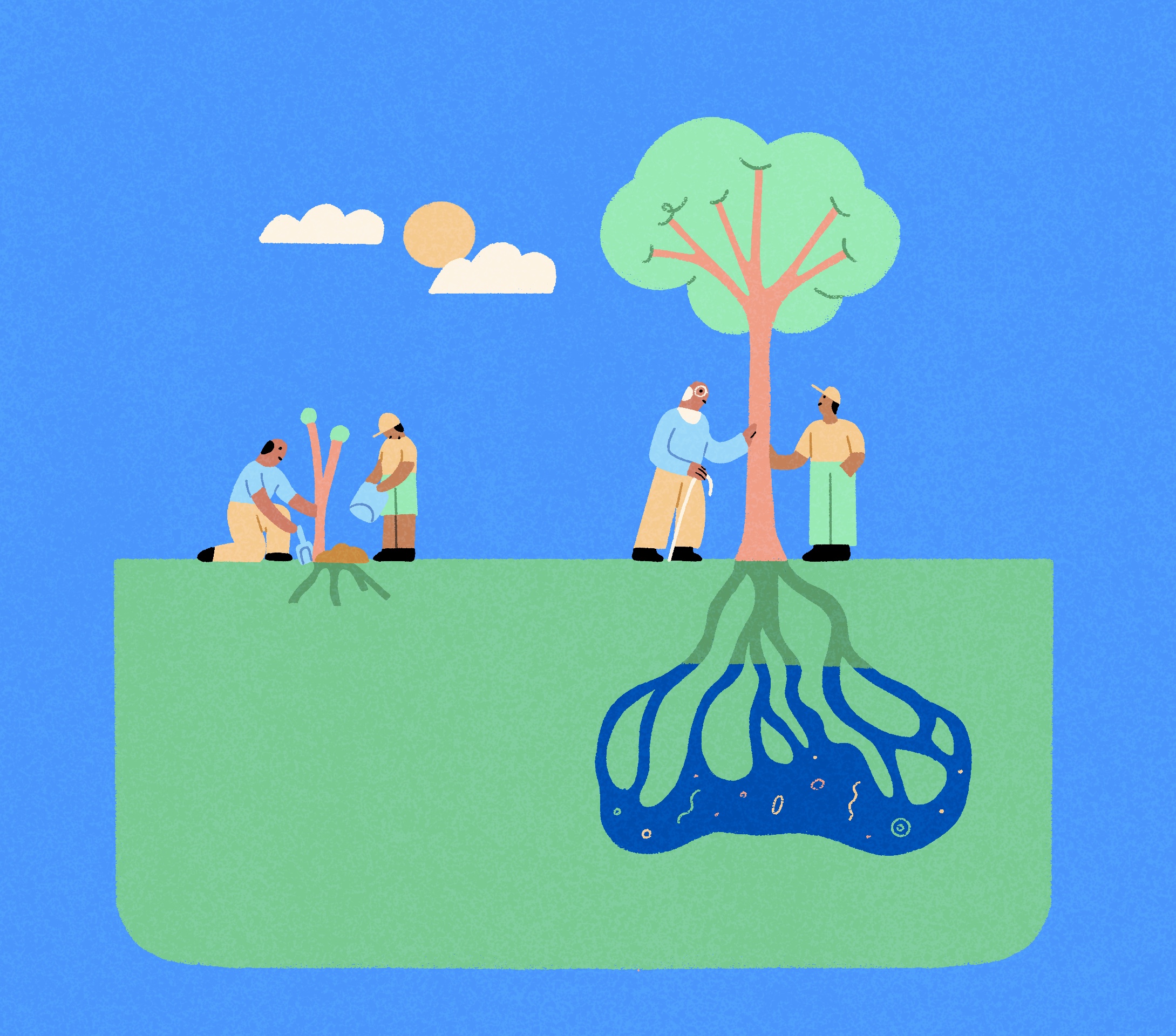
Nature-based solutions interrupt this degradation cycle by addressing its root cause: the loss of soil functionality. By restoring vegetation cover, soils are no longer exposed to direct rain or wind impact, significantly reducing erosion. Vegetation—whether grasses, shrubs, or trees—slows surface water through friction, allowing it to infiltrate instead of carrying fertile particles away.

Roots play a central role in this process. As they penetrate the soil, they stabilize it, reinforce slopes, and create channels that facilitate infiltration. At the same time, the biological activity associated with roots (bacteria, fungi, and small organisms) helps restore soil structure: improving aggregation, increasing porosity, and enhancing moisture retention.
Rather than “controlling” erosion as an isolated phenomenon, NbS rebuild the soil’s capacity to fulfill its hydrological function. A healthy soil behaves like a living sponge: it absorbs water when it arrives, stores it temporarily, and releases it gradually—sustaining water flows while reducing both water loss and risks linked to extreme events.
One of the most common misconceptions around water replenishment is assuming that infiltration automatically leads to aquifer recharge. While related, they are not the same. Infiltration is only the beginning of a long, slow journey, deeply shaped by soil, geology, and climate.
When rainwater infiltrates the soil, it does not immediately “disappear” into deep groundwater. Instead, it enters an intermediate phase with multiple possible outcomes. Some of it is stored as soil moisture—an essential reserve for plants and microorganisms. Another portion is taken up by vegetation and returned to the atmosphere through evapotranspiration. Some evaporates directly from the soil. Only a fraction—often small—continues its slow descent through deeper layers until reaching the saturated zone, where true aquifer recharge occurs.
This journey can take years or even decades. Its speed depends on factors such as aquifer depth, impermeable layers, soil structure, slope, and rainfall patterns. In regions like much of Mexico—where aquifers are deep and often overexploited—the time lag between rainfall and effective recharge is particularly pronounced.
For this reason, aquifer recharge does not respond well to short-term solutions. It cannot be artificially accelerated without consequences. It is, fundamentally, a cumulative process that depends on maintaining favorable conditions so that infiltrated water is not lost before reaching its destination.
Here, again, NbS play a critical role—but expectations must be adjusted. They do not promise instant recharge or short-term visible results. What they do—effectively—is systematically improve the probability of recharge: increasing effective infiltration, reducing surface evaporation, extending water residence time in soils (and therefore vegetation persistence), and promoting slower, deeper flows.
In practical terms, restoring soils, recovering vegetation cover, and reducing compaction do not “fill” an aquifer overnight. What they do is rebuild the pathway that allows, over time, a greater share of rainfall to become groundwater.
In a country facing chronic aquifer deficits, this distinction is essential. Understanding that infiltration is not recharge is key to designing water replenishment strategies that are responsible, measurable, and aligned with the real timelines of nature. It also helps companies, communities, and decision-makers recognize that meaningful water impact is not measured only in infrastructure, but in restored processes sustained over time.
A watershed is a living network. Rainfall, soil, vegetation, aquifers, and people form an interdependent, sensitive, and dynamic system. Intervening in one part without understanding the whole often leads to partial solutions that shift problems rather than solve them.
Water replenishment does not happen because it is declared, nor because isolated volumes are accounted for. It happens when landscapes recover their ability to receive, infiltrate, store, and release water in a functional way. From this perspective, nature-based solutions are not a shortcut—they are a responsible way forward.
For companies and organizations, this means moving from abstract impact compensation toward investing in the functionality of the systems that make water possible.
High-quality climate action is not measured only by numbers or projects delivered, but by the ability to sustain benefits over time—even under increasing climate stress. Understanding a watershed ultimately means understanding the limits of what is possible—and where the opportunities to act better lie. And acting better today means working with nature, not simplifying it.
Sandra is a biologist who remains in constant awe of the living world. Deeply moved to be writing again for Toroto, she is currently leading an ecological restoration project on the outskirts of Lake Texcoco, among birds, sunlight, and wetlands.

Explore reflections, research and field learning from our work in ecosystem restoration.